


Breast is best - but is there an age where breastfeeding becomes too much of a good thing? Sadie Morgan takes a look at extended breastfeeding.
The length of time for which a child is breastfed is a very personal decision, yet fraught with controversy. Daytime talk shows and prime-time "documentaries" (like the recent episode of Real Life on TV One entitled "Honey, I Suckled the Kids") paint extended breastfeeding as a subculture rather than the norm; even the show's description (which also discusses attachment parenting, the use of baby slings, and co-sleeping) on the TV One website says, "Sitting to the extreme right and left of the conventional parenting spectrum, so taboo are some of these practices that some parents have gone underground to avoid being judged." Going underground to avoid judgement on how you feed your child - now there's a comforting thought.
The World Health Organization (WHO) recommends that "infants should be exclusively breastfed for the first six months of life to achieve optimal growth, development and health. Thereafter, to meet their evolving nutritional requirements, infants should receive nutritionally adequate and safe complementary foods while breastfeeding continues for up to two years of age or beyond." However, despite these recommendations, "No more than 35% of infants worldwide are exclusively breastfed during the first four months of life; complementary feeding frequently begins too early or too late, and foods are often nutritionally inadequate and unsafe." Furthermore, WHO's own data shows that by the age of two years, only 20% of children are still receiving breastmilk. That means that 80% of children are not being breastfed in line with worldwide standards. Why don't more women breastfeed their children for extended periods of time? And for those women who do practice extended breastfeeding, what's it really like?
The right start
Breastfeeding is a natural act, and one that the female body is designed to do following the birth of a child. However, it is a practice that must be learned, and doesn't necessarily "come naturally" to women. Contemporary New Zealand mothers are giving birth to their first children in a culture where large families are no longer the norm. Instead of growing up surrounded by relatives and helping care for younger siblings and cousins, families are smaller and more far-flung. There is little opportunity for first-time mums-to-be to observe other females breastfeeding their children; to absorb this practice into their own psyches and know, without question, that they will undoubtedly feed their own babies this way. Instead, breastfeeding has become a subject that is "either/or", with women thinking, "Well, if I can't breastfeed, I'll just formula-feed." The trouble is, when it comes down to whether a woman "can" or "can't" breastfeed, anecdotal evidence suggests that society is still not giving women enough support, either with breastfeeding or with formula-feeding.
As WHO asserts, "Virtually all mothers can breastfeed, provided they have accurate information, and support within their families and communities, and from the health care system. They should also have access to skilled practical help from, for example, trained health workers, lay and peer counsellors, and certified lactation consultants, who can help to build mothers' confidence, improve feeding technique, and prevent or resolve breastfeeding problems."
But who among your friends was lucky enough to have all of this incredible support? For most mothers in New Zealand, three days in hospital is the longest they'll get, and for many mothers of newborns, by the time they leave hospital, their milk hasn't even come in. The need for support comes weeks later, in the middle of the night, when they're sleep-deprived and hormonal, trying to latch a screaming baby onto a sore nipple. It's no wonder only 35% of infants worldwide are exclusively breastfed for the first four months of life. Many mothers can't see the benefit of breastfeeding for longer when their immediate experience is of pain, confusion, and the feeling of being "over it".
Making it work
For women who do breastfeed for extended periods of time, there seems to be a societal "cutoff point" that occurs when their babies are around one year of age. This is the time when friends, family, and even perfect strangers start making comments and enquiring as to when the child is going to wean.
Claire Andrews, who is the mother of a 23-month-old boy, and also pregnant with her second child, has experienced this firsthand. She gave birth to her son, Marcus, with the intention of breastfeeding him for as long as he wanted to be fed. But she felt like an outsider in her antenatal group, and as her son got older and continued to breastfeed, she felt more and more marginalised.
"I think I started to notice a difference around the six-week mark. Other mums in my antenatal group were starting to express breastmilk so they could have a break, and I wasn't. Also, the others were trying to get their babies into a feeding routine rather than demand-feeding. I always just fed Marcus whenever he wanted it, regardless of how long ago I'd fed him. I didn't worry about the clock. I never had a problem with supply, as Marcus was fed a lot, so my body just made what he needed.
"When the other babies in antenatal group started to bite, a few of their mothers weaned them right away, whereas I put a lot of effort into teaching Marcus not to bite me. I really noticed how different I was when Marcus got to a year old, and I only knew two people outside of La Leche League who were still breastfeeding. It was a very lonely feeling when the last person in my antenatal group weaned her child. I felt like I was a freak."
Despite initial misgivings, Claire joined her local La Leche League group, and quickly realised that she was not only accepted without judgement, she was treated as though there was absolutely nothing abnormal about breastfeeding a toddler - which was a huge change from what she'd experienced with her antenatal group, and even within her own family.
"It's amazing what people will say about breastfeeding when they don't even know you. One of the most difficult things for me to contend with was the lack of support from my parents with regards to breastfeeding. Soon after Marcus was born, my father called to tell me that a customer of his workplace, who'd had a baby a few weeks before I did, kept telling him how wonderful it was that her baby was sleeping through the night - and he was on formula. Every time she'd come into his workplace, she'd tell him about the formula, and Dad would ring me up afterwards with the details of the formula so I could get it for Marcus. My mother even called to tell me that I was weaned at three months because I cried too much, and that I should wean Marcus, as he was obviously crying out of hunger and needed more than my milk to help him sleep."
Shocked, Claire turned to the La Leche League and parenting books for information and advice, but quickly realised that the messages she was hearing were conflicting. "All through antenatal classes, and in all the parenting books I read, breastfeeding was clearly the best decision for both mother and child. I thought that everyone agreed on this. But it turned out that despite what I was reading about the benefits of persevering with
breastfeeding, society still looks at breastfeeding as something that should have a time limit on it."
Benefits of extended breastfeeding
Breastfeeding a child for a length of time has been shown to have significant health advantages for both the mother and child.
The La Leche League International states, "All the benefits of human milk - including nutritional and health - continue for as long as your baby receives your milk. In fact, as your baby takes less human milk, these advantages are condensed into what milk is produced. Many of the health benefits of human milk are dose-related; that is, the longer the baby receives human milk, the greater are the benefits."
Recent studies confirm that breastfeeding for a longer time actually imparts greater benefits to the breastfed child. Children who are breastfed for a significant period of time:
• Have a reduced risk of obesity in later life.
• Have improved cognitive development and performance in childhood.
• Have higher IQs than those children breastfed for less than seven months.
• Have a significantly lower risk for cardiovascular disease.
• Have a lower risk of respiratory infections such as pneumonia and otitis media (glue ear).
But not only is extended breastfeeding beneficial for the child, it's also beneficial for the mother. Mothers who breastfeed their children for an extended period of time:
• Have a decreased risk of breast cancer, ovarian cancer, uterine cancer, and endometrial cancer.
• Are more protected against hip fractures and osteoporosis in the postmenopausal period.
• Have a reduction in the likelihood of later development of Type 2 diabetes (this reduction is greater with each year of breastfeeding).
• Have a reduced risk of developing rheumatoid arthritis.
Claire explains, "Knowing that I'm doing all that I can to set Marcus up for life, healthwise, is extremely important to me. Breastfeeding is so easy (once established and learned), yet the benefits are incalculable, both in terms of health and emotional development."
Breastfed toddler = 'Mummy's boy'?
The health benefits of extended breastfeeding are clear, but this doesn't seem to be what society has the biggest problem with. For many people, the thought of a toddler being breastfed is appalling, and fears for breastfed toddlers' social and emotional development are rife. "When he's old enough to ask for it, he's old enough to be weaned!" seems to be the pervading sentiment among mothers who are breastfeeding.
Yet research shows extended breastfeeding does not have a detrimental effect on the social, emotional, or psychological adjustment of a child. In her article "Nursing Beyond One Year", Sally Kneidel explains, "Research reports on the psychological aspects of nursing are scarce. One study that dealt specifically with babies nursed longer than a year showed a significant link between the duration of nursing and mothers' and teachers' ratings of social adjustment in six- to eight-year-old children (Ferguson et al, 1987). In the words of the researchers, 'There are statistically significant tendencies for conduct disorder scores to decline with increasing duration of breastfeeding.'"
According to Katherine Dettwyler, PhD, "In societies where children are allowed to nurse 'as long as they want', they usually self-wean, with no arguments or emotional trauma, between three and four years of age."
Additionally, research into natural weaning age by Dettwyler has found that "human children are designed to receive all of the benefits of breast milk and breastfeeding for an absolute minimum of two and a half years, and an apparent upper limit of around seven years."
But in choosing to allow a child to breastfeed for "as long as he wants", is the mother creating an unhealthy dependency between herself and her child? Children need their mothers - we're the only species on the planet born completely and utterly helpless, and without our mothers' help, we wouldn't survive. Children are inherently dependent on their mothers, and independence cannot be rushed. Children need to achieve independence at their own pace in a secure, loving environment where they are safe in the knowledge that someone is looking after their needs. This kind of self-led independence, once attained, is more secure than if children are forced into independence prematurely. As Elizabeth Baldwin explains in her article "Extended Breastfeeding and the Law", "Meeting a child's dependency needs is the key to helping that child achieve independence. And children outgrow these needs according to their own unique timetable."
Milk for two?
Tandem breastfeeding is another cultural taboo, and one that's misunderstood. "How can one woman have enough milk for two babies?" is the most commonly asked question, but research - and experience - prove that the female body is capable of making enough milk for multiple infants. Many women wean their breastfeeding children in order to get pregnant with another child, or because they have recently learned they are pregnant again. But it's possible to keep breastfeeding through pregnancy and beyond.
For Claire, who is pregnant with her second child and still breastfeeding Marcus, it has not been easy - but she has persevered. "At the beginning of this pregnancy, it was awful. My nipples hurt, and I was so exhausted that I would often sit down to feed Marcus and just cry. When I was about three months pregnant, I got mastitis for the first time. During that time, it was so awful feeding Marcus, as it was so painful. But breastfeeding was the only thing that helped. Because of the change in the flavour of my milk due to the infection, Marcus wasn't that keen to feed, which stressed me out and made the mastitis hurt more. But talking to one of my La Leche League leaders helped me to calm down and not put so much pressure on Marcus to nurse, which led to our stress levels reducing, and he gradually started breastfeeding again.
"About a month after the mastitis cleared up, Marcus started dropping feeds, which really upset me. I felt like such a failure and dreaded feeding times, in case Marcus turned me down. But again, I talked to one of my La Leche League leaders about the situation, and just allowed Marcus to lead the way. Soon he was feeding again, and even went to four feeds a day when he had only been having three feeds a day for a few months.
"When my third trimester started, the dreaded sore nipples returned, and my milk supply dropped. For a long time, I was sure that Marcus wasn't getting anything, and was more or less just nursing for comfort. But then he started feeding for longer periods of time. Sometimes I have to tell him, 'Just one more minute!' and then take him off, as my nipples hurt too much.
"For a while in the middle of my pregnancy, Marcus's weight on my bump would make me feel sick. Even with him supported by a pillow, the weight on my stomach was too much. But that phase was soon over, and it hasn't been a problem since."
Indeed, as the La Leche League International says of breastfeeding while pregnant and tandem breastfeeding, "Some mothers express concern that their toddler may be taking milk meant to nourish their baby. These mothers may take comfort in the fact that breasts are marvellous things that can adjust their production to meet the demands placed upon them - if they are asked to produce enough milk for two, they usually can! Also, most toddlers breastfeed considerably less frequently than an infant, and get most of their nutrition from other foods."
Supporting extended breastfeeding
"It would really help me to feel encouraged to keep breastfeeding if society would stop looking at me like I'm a weirdo," Claire says. "I am doing the best for my child, and I want people to recognise and respect that."
For women who breastfeed their babies longer than the "norm", the feeling of being somehow separate from polite society is incredibly upsetting - and so it should be. Breastfeeding is normal and natural, and its benefits are evident.
As Claire explains, "Right from Marcus's birth I've set breastfeeding goals. First it was just to get through one feed, as it was so hard to get him started. He was severely tongue-tied, and from birth I was told he wouldn't be able to breastfeed, but we did it. Once we got past one feed, my goal was six weeks, than six months, then a year, and then two years. I have no goal past two years. I really want Marcus to wean himself when he is emotionally ready. If you had asked me even a year ago if I would still be breastfeeding at 23 months, I would have said, 'Probably not.' Now we will just have to see what happens. I'm in no hurry for Marcus to wean himself, as I love the intimacy of breastfeeding, and I know that every drop of milk Marcus gets from me is beneficial to him."
What is the one thing Claire would love people to stop commenting on? "When people ask me, 'Are you still feeding him?' I get really annoyed. I always want to reply, 'Oh, bugger, I knew there was something I forgot to do.' Society doesn't own my breasts, so I want people to stop acting as though they have a right to tell me what I should or should not be doing with them."

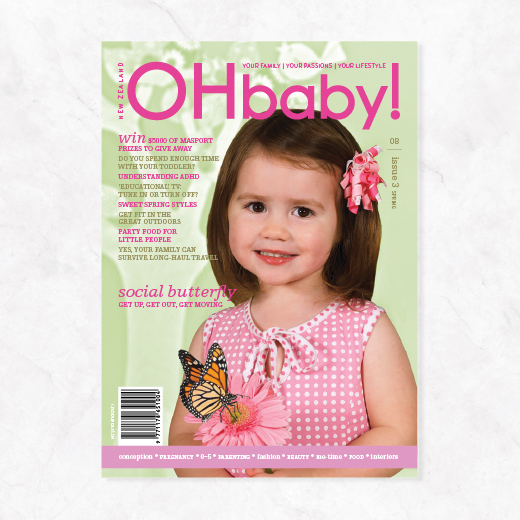
AS FEATURED IN ISSUE 3 OF OHbaby! MAGAZINE. CHECK OUT OTHER ARTICLES IN THIS ISSUE BELOW












Cookie Policy | Terms & Conditions | Privacy policy | Copyright © 2024 www.ohbaby.co.nz. All Rights reserved.