

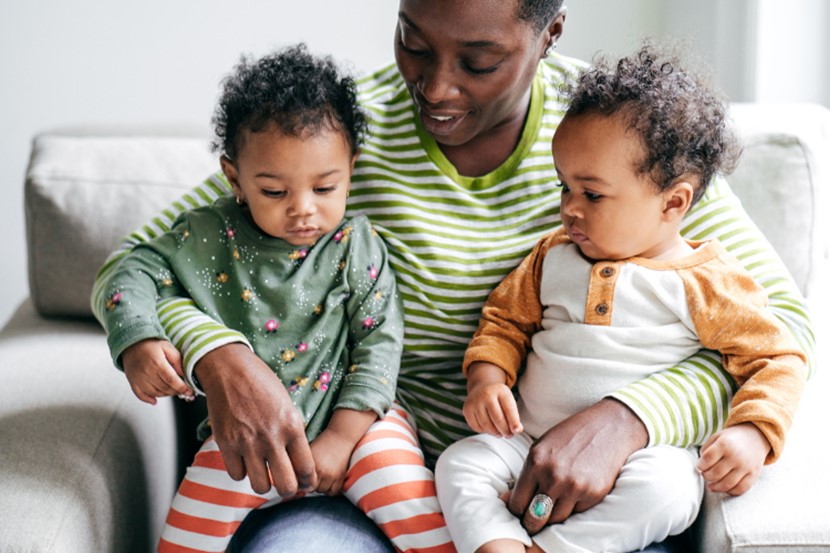
Are twins really two halves of the same person, or are they just two individuals who happened to be born at the same time? And can they really read each other's minds? Emma Fahy explores the facts behind some fascinating twin theories.
There's something fascinating about twins, and despite the increasing occurrence of twins associated with assisted reproduction, they retain a sense of mystery and uniqueness that we singletons can't help but envy. From the ill-fated Biblical pair Jacob and Esau and the mythical founders of Rome, Romulus and Remus, to modern-day heroes like the Evers-Swindell sisters, history is peppered with famous twins, often shrouded in mystery and intrigue. Perhaps it's because, unlike many animals, human beings simply aren't designed to gestate more than one baby at a time, so the very existence of twins is, in itself, a miracle.
The fascination with twins goes back as far as Hippocrates, the father of modern medicine, who first conceived the concept of genetics while studying sets of twins. Hippocrates identified a pair of brothers who shared many of the same physical traits, and hypothesised that this was because they had been born at the same time, and had therefore been subjected to a similar experience prior to birth. Since then, twins as a group have been widely studied, but the conclusions have been varied and contradictory - they remain almost as much of a mystery today as they did when Hippocrates carried out his research in ancient Greece. Much of the mystery surrounds the relationship between twins, and how this affects their lives.
It's a twin thing
There's no doubt that twins share a unique closeness - while most of us spend our time in the womb in solitude, research shows that twins begin to interact with each other from as early as 16 weeks gestation. The National Geographic documentary Inside the Womb: Identical Twins shows fascinating ultrasound footage of twins holding hands and kicking each other in what appear to be quite deliberate movements.
Dr Alessandra Piontelli studied the conduct of both twins and singletons in utero and concluded that some twins appear to actively seek each other out, behaviour which continues after birth. Let's face it - after nine months of cohabitation in very close quarters, it's not surprising that twins develop a strong bond!
However, while this closeness has its obvious benefits - a constant playmate and source of reassurance and support- it does also have drawbacks. Twins are often described as having a love-hate relationship, and most parents of twins would agree that their children spend a decent amount of each day at war with each other.
Co-dependency is also a problem in some twin pairs - sometimes the closeness of the relationship between the twins leads to a mutual reliance on each other. This is not helped by our societal perception of twins as a single unit. Research has shown that young twins often identify themselves as a single unit, and define their own lives by their twinship, a result of being constantly labeled "The Twins". Evidence suggests that this is more of a problem for identical twins, and to a lesser degree, same-sex fraternal twins, than it is for boy-girl twins - after all, we're not likely to mistake boy-girl twins for each other, something which happens frequently for same-sex twins!
As twins grow older and begin to explore their own identities, most are able to form healthy relationships with others, but studies show that when asked who their closest friend is, more than half of all adult twins still name their twin sibling, even ahead of their spouse.
Does identical really mean identical?
Most of us are aware that there are two different types of twins: Identical and fraternal. But what many people don't realise is that while identical twins might look the same, they are each complex and different individuals. Identical twins share the same DNA profile, but each has their own fingerprints. They have the same eye, hair, and skin colour, but the shape of their heads and faces often differs as a result of the differing positions they lay in inside the womb, and variations in the blood supply through each twin's umbilical cord. They usually have similar IQs, but do not necessarily have identical personalities - in fact, they are often polar opposites. One twin may be left-handed, while the other is right-handed, and although dressing identical twins in matching outfits might be cute when they are newborns, by thetime they reach preschool, they will likely be asserting their own individuality by choosing to wear something different. As for telling them apart, the myth that a mother can always tell her twins apart is exactly that, a myth - in the haze of the early days, most twin parents choose something more reliable than their own sleep-deprived brains to distinguish their babies, such as an ID bracelet or different-coloured toenail polish. As toddlers, identical twins even have trouble telling each other apart - when they look in the mirror, is it their twin staring back at them?
As they grow, the differences become more obvious, but it's fair to say that even as adults, identical twins often have to grin and bear it when mistaken for each other. This does, of course, have its advantages - a pair of twins in Germany recently escaped conviction for an aggravated robbery because police were unable to determine which of them had committed the crime!
Twin speak
It's generally accepted that twins are slower to acquire language skills than singletons - around one child in 10 will experience language delays, but this figure is significantly higher for twins. On average, they are around six months behind their singleton peers when it comes to speech milestones, but the reason for this is unclear. Some experts believe that it is because they develop their own private language, known as "twin speak", or cryptophasia, and therefore don't need to learn conventional speech at an early age. This twin speak may be the result of their intense interpersonal closeness, or it may be simply a case of each twin mirroring the other's immature speech patterns.
Twins also spend less time engaged in one-on-one communication with their parents, and more time communicating with each other during play, so it makes sense that they understand each other's seemingly incomprehensible babble. However, another explanation for this delay in verbal skills is that twins are more likely than singletons to be born prematurely, and to be low birth weights. Prematurity is recognised as a leading cause of language delay in children, and the average twin gestation is only 36 weeks, compared to 39 weeks for a single fetus pregnancy.
Twin telepathy
We've all heard the stories of twins who can read each other's thoughts, and who know when their twin is in pain despite being on other sides of the country. Indeed, twin telepathy is one of the most fascinating facets of twinship. One famous example of apparent twin telepathy is the "Jim twins" from Ohio, USA. Separated at birth and raised by adoptive families, both were christened James, and when they first met each other in their early 40s, they discovered that they had both married women with the same name, had named their children the same names, smoked the same brand of cigarettes, shared many hobbies and interests, and had parallel medical histories. While many of these similarities can be dismissed as coincidence - for example, the name James was popular at the time they were born - the sheer number of similarities lends weight to the theory that the pair shared some kind of telepathic link, despite being unaware each other even existed.
But can twins really read each other's minds? To date, no scientific studies have proven the existence of a telepathic link between twins, and anecdotal evidence is far from reliable. Twins do demonstrate an uncanny ability to know what each other is thinking, but those who have studied twins and their behaviour believe that this is a result of living closely with each other for an extended period of time, and point out that twins score no better in telepathy testing than siblings who have been raised together.
For every question that is answered about twins, several more arise. After thousands of years of exploration, it seems likely that research into the twin phenomenon will continue to fascinate us for many years to come, and with the rise in IVF and other assisted reproduction techniques, it seems certain that there won't be a shortage of twins to study.
| Emma Fahy is the former OHbaby! Web Editor and mum to four girls, including identical twins, Sienna and Mercedes, who hated being in the same bassinette as newborns, but now fall asleep in each other's arms most nights. |

AS FEATURED IN ISSUE 9 OF OHbaby! MAGAZINE. CHECK OUT OTHER ARTICLES IN THIS ISSUE BELOW












Cookie Policy | Terms & Conditions | Privacy policy | Copyright © 2026 www.ohbaby.co.nz. All Rights reserved.