


Whether or not to give your baby a dummy is a controversial topic among parents. Some parents feel it's an essential tool; others think it's an unnecessary vice. Elizabeth Gasson explains why she gave her son a dummy, and looks at the pros and cons of using one.
"If you give that baby a pacifier, you'll ruin his teeth!"
"Don't give her a dummy - it will be so hard to break the habit."
"Get that binkie out of his mouth!"
Dummies get so much negative press, new parents who want to use them must feel a bit like they're doing something illicit. Often, the use of a dummy is accompanied by a shamefaced and apologetic, "Oh, I know it's not good for her, but it's the only thing that will keep her happy!" as the offending parent surreptitiously maneuvers said dummy into their child's mouth and holds it there until the relieved baby starts merrily sucking away. Dummy-using parents face negative criticism, dirty looks, and disapproving "Tsk, tsk" noises from friends and strangers alike. And the older your child is, the more other people feel it's their right to condemn.
As new parents, my husband and I made a choice to give our baby a dummy when he was only a few weeks old. Our decision may have had something to do with the fact that our baby was premature, and the neonatal staff suggested that we use one, as it would help to develop his sucking reflexes for nursing. Now that Johnathan is a year old, I'm pleased we decided to use a dummy. I have seen the benefits of it firsthand: It's an automatic soother, especially at night, and he's a much stronger feeder. But I haven't been immune to society's judgemental attitude toward the great dummy dilemma.
Whether or not to use a dummy has been a controversial subject for a long time. It seems that you either agree with using one or you don't agree at all - there is no middle ground. When I have taken my little one to play groups, I have been subjected to more than one disapproving glare from other mothers when my son comes in sucking on a dummy. I have even had a few direct comments about the negatives of using one - dependency seems to be the most common reason people give. But as I heard someone say on a popular talk show recently, "Have you ever seen a 40-year-old man sucking on a binkie?"
I have to admit that I am slightly worried about what I am going to do in order to "break" my son's dependency on his dummy when the time comes. I have read a few books and have asked a few parents, but the information all seems to be the same. It looks like we have two choices: We can go cold turkey, or let him give up the dummy himself when he's ready.
Some cultures are more accepting of the use of a dummy than others. According to an article published in 2006 in Pediatrics magazine, "The use of pacifiers varies considerably between countries and also within countries. In New Zealand, the prevalence of pacifier use was low (10.4%), but within the country varied from 3.6% in the southern South Island to 32.3% in the northern North Island. In other countries, much higher pacifier use has been reported. In European countries, pacifier use varies between 36% and 71%. There is little information as to the reasons for such wide variation between countries and why pacifiers are introduced. Turkish and Moroccan people dislike thumb-sucking and they actively try to prevent this by offering the breast and/or a pacifier."
Why might a dummy be a good thing?
Recent research from the American Paediatric Association and Kaiser Permanent has shown that the giving babies, especially ones who are more prone to SIDS, a pacifier has drastically reduced the rate of SIDS by up to 90%. Researchers believe that it is due to the child's sucking reflexes while using the dummy, which may help to rouse the child from a possibly deadly deep sleep.
Dummies may also help to provide "increased protection from an unfavourable sleeping environment"; that is, sleeping on the child's face or side.
Dummies also are a great way of making sure no nasty objects are accidentally put into baby's mouth. However, it's important to always watch your baby, as dummies are not a fail-safe method for preventing choking.
It is said to be easier to break the habit of using a dummy than it is to stop thumb-sucking. And dummies are also generally cleaner than thumbs - and if they get grubby, you can always sterilise them!
Why you should think twice
If your baby becomes dependent on the dummy, especially at night to sleep, you might have a few waking cries in the night when the baby has "lost" the dummy. It is not recommended to use dummy clips when sleeping, especially if they are long enough for the cord to become wrapped around baby's neck.
The Mayo Health Clinic has stated that using a dummy may increase the risk of middle-ear infections in young babies. However, rates of middle-ear infections are generally low in the first zero to six months of life, when the risk of SIDS is the highest. This is also the time when your baby may be most interested in the dummy.
Although there is controversial research about this point, the Mayo Health Clinic suggests that very early use of the dummy may interfere with establishing breastfeeding, as the texture of the dummy is different than the breast or bottle.
Some research has suggested that the prolonged use of a dummy may delay speech. However, there does not seem to be strong evidence for this. As for dental problems, again, the Mayo Health Clinic and the American Paediatric Association have stated that using a dummy in the first few years of life does not cause long-term dental problems. However, long term, persistent use (as with thumb-sucking) can cause the top front teeth to become slanted out or the jaw to become misaligned.
The decision to use a dummy is a personal one, and whether or not you choose to use one will depend on your family's circumstances. And if you do choose the dummy, rest assured your child is unlikely to be still sucking it when he's 40.
The history of the dummy
Dummies first appeared on the scene in around 1800, patented in the US as a "baby comforter". The design was similar to modern dummies, with a rubber teat, a shield, and a handle. Unfortunately, they quickly earned a reputation as something that the "lower classes" would use, and were associated with poor hygiene. The practice of picking up a dropped dummy from the floor and rubbing it on your shirt before popping it back into baby's mouth is not solely the preserve of contemporary parents - an article published in the British Journal of Nursing in 1915 featured a complaint by a doctor bemoaning the "dummy teat" which, "If it falls on the floor, it is rubbed momentarily on the mother's blouse or apron, lipped by the mother and replaced in the baby's mouth."
Elizabeth Gasson is Mum to one boy.

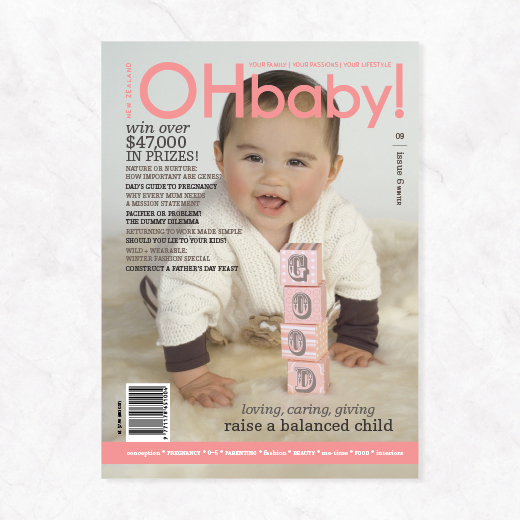
AS FEATURED IN ISSUE 6 OF OHbaby! MAGAZINE. CHECK OUT OTHER ARTICLES IN THIS ISSUE BELOW













Cookie Policy | Terms & Conditions | Privacy policy | Copyright © 2024 www.ohbaby.co.nz. All Rights reserved.