

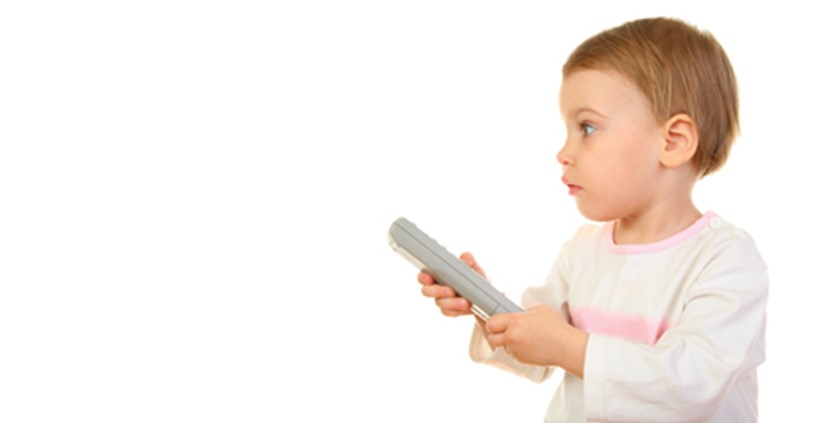
Is it time to take a break from television advertising for children? Emma Fahy investigates the impact of 'boxed propaganda' on little ones, and seeks to answer the questions of how much TV advertising children are absorbing, and what parents can do about it?
You could have knocked me off my chair with a feather when my five-year-old daughter Maya sat down at the breakfast table one morning and announced that she was having "Nutri-Grain for breakfast, 'cause it's got corn, oats, wheat, niacin and iron in it, Mama." I cringed in embarrassment, thinking, "Exactly how much television is this child watching, and, more importantly, how much advertising is she being exposed to?"
Now, I'm not naïve enough to believe that my children exist in a bubble, cut off from the evils of the outside world: At two, Maya could recognise the ubiquitous Golden Arches; by two-and-a-half she could recite The Warehouse jingle, never forgetting that as well as a bargain, the consumer also gets a "money-back guarantee". But the Nutri-Grain incident really threw me - I had no idea just how deeply advertising was working its way into her thinking until I heard her reciting words she didn't even know the meaning of and using them to justify her choice of breakfast cereal.
In hindsight, I don't know why I was so surprised. In the average 30-minute TV segment, we are exposed to up to nine minutes of advertising and, while the saturation might be slightly lower for children's TV programs, the impact is potentially even greater.
Children's minds are permeable; they are like tiny sponges soaking up every single experience they have, and, as anyone who has a preschooler will know, they have memories to rival the poor old clichéd elephant. In short, they are an advertiser's dream. It's not hard to use advertising to appeal to young children. A bit of color, a catchy jingle - many savvy agencies even create company "mascots" for their clients in order to attract and retain greater attention: Think Ronald McDonald, the Griffin's Cookie Bear, and the Popsicle Band.
However, children's TV advertising is by no means a free-for-all, unregulated environment. All TV advertising in New Zealand must adhere to the codes of practice outlined by the Advertising Standards Authority (ASA), and, in addition to the general guidelines, advertising aimed at children, or shown during children's viewing times, is subject to the Code for Advertising to Children. According to the ASA, special care must be taken when advertising to children, and the purpose of the Code is to safeguard the interests of children, while recognising that advertising is a useful tool for informing children not only about products and services, but also about the world in which they live.
In New Zealand, advertising during programmes aimed specifically at children under five is kept to a minimum. For example, during the early-morning segment on TV2 which features shows such as Blue's Clues and The Go Show, the programming itself is not broken up by advertising segments. But cartoons aimed at slightly older children, and certainly the post-3pm children's viewing slot, are saturated with advertising, and it's this time that your child is bombarded with the latest Barbie doll to hit the market, the newest addition to the Hot Wheels range.
So what exactly is so bad about TV advertising? According to the Royal Australasian College of Physicians, children in New Zealand and Australia are exposed to some of the highest rates of TV advertising in the world, and they estimate that a child watching an average of 2.5 hours of TV per day will be exposed to around 25,000 advertisements per year. That's a lot of advertising! Furthermore, they assert that TV advertising works, citing an American study in which the sales of toys directly linked to TV advertising rose from 10% in 1984 to 50% in 1990.
One of the biggest problems posed by TV advertising is the difficulty young children have differentiating between advertising content and the program itself. Young Media Australia, an organisation set up to monitor and evaluate media consumption by children in Australia, say that this can be particularly harmful as children under five don't recognise that the advertisements are trying to sell a product or service. This becomes even more complicated when you consider that a lot of toys being advertised are based on the TV shows during which they are advertised.
For example, when English children's TV show In The Night Garden hit the screens here in 2007, it was closely followed by a range of show-themed dolls, books, and clothing. For a two- or three-year-old, it is impossible to differentiate between the Iggle Piggle character they see in the show and the Iggle Piggle doll they see advertised during the ad breaks.
Food advertising poses its own unique set of challenges. Many of the foods advertised during children's viewing times are high in salt, sugar, and fat, and children don't understand the negative health benefits that excess consumption of such foods can have. In a study cited by the Royal Australasian College of Physicians, a high number of 9-10 year olds surveyed believed that Ronald McDonald probably knew what was good for them to eat. This impact could be even more profound on younger children, who have a far more simplistic view of the world. It is worth noting, however, that many of the major fast-food retailers are now offering more health-conscious choices, and this is filtering down into children's TV advertising. An example of this is the series of advertisements currently being run by McDonald's to promote their new Happy Meal Healthy Options.
So how do we minimise the impact that TV advertising has on our children? Well, the solution might seem simple - don't let them watch TV! But in today's society, this isn't a practical solution, and besides, even if you turn off the TV, advertising is still all around us, on billboards, the internet, and even at bus stops. It's impossible to shield your children from it forever.
However, there is a lot to be said for limiting your child's screen time and for maintaining close supervision of exactly what they are watching. Experts differ on what they consider to be the "optimum" screen time for children under five, but the general consensus seems to be that around one hour a day is plenty.
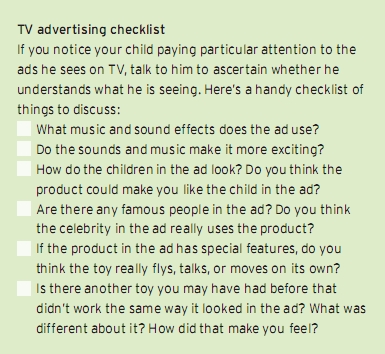
Following this, a good way to help your children understand TV advertising is to watch with them and talk to them about it. A good starting point might be to talk to your child about needs versus wants. He might need a new pair of shoes, but he wants the shoes he saw the All Blacks wearing in the TV commercial. At age three, he might not necessarily remember the brand name, but he remembers the context, and everyone knows the All Blacks are cool. Whether you decided to go with the All Blacks shoes or not, explain to him that you made the decision based on a number of factors, including quality, cost etc.
Most importantly, don't let your children's TV advertising viewing have a major impact on your purchasing decisions. Advertising does have a purpose. It alerts us to new products on the market and where to get the best deals, which is undoubtedly a good thing. But as Young Media Australia point out, children are effective influencers on family purchases and they have very little concept of other factors which adults take into account when making purchasing decisions, such as cost and value for money. It's one thing to buy your child the doll she saw advertised on TV as a Christmas present, but if you continually give in to their demands to buy things they've seen on TV, it is a potentially slippery slope.
Remember, too, that not all advertising is bad. Community and government groups, and even corporates, also use advertising to push health, safety and social awareness messages and advertising is a particularly useful and effective medium for this. One of the earliest examples of TV advertising being used to promote child safety is the McDonald's/NZ Police Make It Click series of advertisements encouraging children to buckle up when they're in the car.
More recently, TV advertising has been used to encourage children to eat their vegetables and get regular exercise. Research has shown that this sort of socially-conscious advertising has just as much impact on children as commercially driven, "Buy me!" advertising. The same five-year old who lectured me on the benefits of Nutri-Grain also regularly reminds me that smoking is bad for our bodies.
It seems to me that the answer to the problem of children being bombarded with TV advertising is as simple as the answer to most things in life - "Everything in moderation." We might not be able to control what ads our children are exposed to, but we can control the amount of time in which they watch TV, and therefore advertising, and if all else fails, we can always exercise our parental override powers when it comes to buying.
I probably will keep buying Nutri-Grain, though. Not because it has corn, wheat, oats, niacin and iron in it, but because Maya will actually eat it: As we all know, five-year-olds are a fussy bunch and if it takes a bit of advertising coercion to get her to eat a decent breakfast, well, I guess I'm okay with that.
Want to make a complaint?
If you have a concern about an advertisement you have seen on TV, or about children's TV advertising in general, visit www.asa.co.nz to find out how to make a complaint.
Emma Fahy is the former Editor of the OHbaby! website and mum to Maya Grace and twins Sienna and Mercedes, aka The Gremlins. As we went to press, she was having contractions and waiting for her next addition to the family!
Further reading
References and further information
• New Zealand Advertising Standards Authority (ASA) www.asa.co.nz
• Young Media Australia www.youngmedia.org.au
• "Getting in the Picture: A Parent's and Carer's Guide for the Better Use of Television for Children", from The Royal Australasian Society of Physicians. Available at http://www.kidshealth.org.nz or as a hard copy from Health Policy Unit, RACP, Level 6, 352 Kent St, Sydney, NSW 2000, Australia

AS FEATURED IN ISSUE 2 OF OHbaby! MAGAZINE. CHECK OUT OTHER ARTICLES IN THIS ISSUE BELOW












Cookie Policy | Terms & Conditions | Privacy policy | Copyright © 2024 www.ohbaby.co.nz. All Rights reserved.