
Children's optician Steph Cawte explains what parents need to know about their children's vision and eye health.
That first look into your newborn baby's eyes is the most precious experience. As you gaze into those gorgeous eyes, have you ever wondered what they can see? It used to be believed that newborn babies have very little vision and that everything was blurry and only black-and-white. We now know that newborn babies can see quite clearly at a close range and probably have colour vision.
There are two parts to vision - the eye itself and the visual system (how the images are sent to and understood by the brain). The visual system of a newborn is not fully developed, and for the first few months, a baby can only focus up to about 25cm away.
Babies have to learn how to use their eyes in conjunction with their visual system in order to see. They learn to focus, move their eyes, and use both eyes together in order to develop their vision. Even though this learning process is still developing for them, research shows they can recognise their mother's face as early as 15 hours after birth.
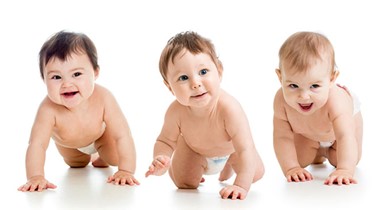
It will take up to six months for a baby to develop depth of field and full colour vision. During the first six months, babies will start to track objects and begin to reach out for them. This starts to develop hand-eye coordination. Crawling also helps to further develop hand-eye coordination. By age two, hand-eye coordination and depth perception should be well developed. Children's visual development is aided by age-appropriate activities such as hanging a mobile above the cot, rolling ball, or using building blocks.
Eye problems are rare in children, but it's important to address any concerns early. Common eye problems in children include:
Parents are usually the first to notice any problems with their child's eyes. Signs to look for include cross eyes, rubbing of the eyes, sitting close to the TV or holding books close, shutting of one eye, tilting of the head, or squinting to see an object. Older children may complain of headaches, double vision, or not seeing clearly.
If you suspect any problems with your child's vision, you should make an appointment for an eye examination. Children need good vision to understand and interact with the world around them. 80% of learning is visual, so it is important that any eye problems are dealt with early.
It is never too young to have your child's eyes examined. The best place for a thorough eye examination for a preschool-aged child is with a specialist ophthalmologist (eye doctor). Once a child is at school, can converse well and knows their alphabet, then they will generally see an optometrist.
Eye patches are used for the treatment of amplyopia, strabismus, and double vision in children. They can be either worn on the eye or on glasses.
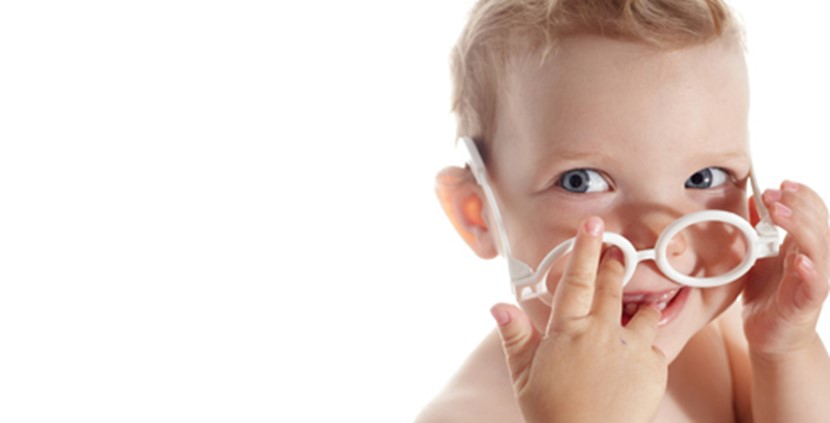
There is a fantastic range of frames available now for children who need glasses, from one-piece soft plastic frames for babies, to super-flexible titanium frames for the athletic child, as well as gorgeous plastic fashion frames for the kids who want something funky - just like Mum and Dad!
When looking for glasses for children, it is important that the frames fit now - don't buy a pair that are too big for the child to "grow into", as they will not be comfortable and will likely fall off and break before they get a chance to fit properly. Children will usually need two pairs of glasses, as one pair will often be getting fixed, since they do have a bit of a rough life compared to adult glasses! It is important to get your children's glasses fitted by a professional - a Dispensing Optician or Optometrist - as they are qualified in frame-fitting and giving lens advice.
There is a huge range of frames available for all age groups, as well as sports glasses, prescription swimming goggles, and prescription sunglasses. Lenses should be impact-resistant for safety. Even if your child doesn't wear prescription glasses, you may want to consider visiting a professional to fit regular sunglasses, too.
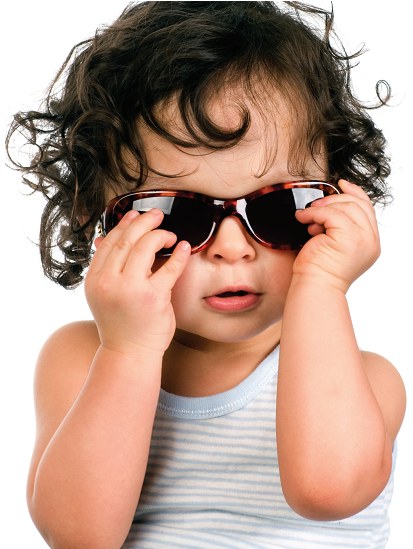
Sunglasses are an important but often overlooked part of eye care for children. Children's eyes are particularly sensitive to UV light and childhood exposure can lead to problems later in life, such as cataracts and age-related macular degeneration. It is therefore important for children to wear quality, well-fitting sunglasses in bright sunlight.
When a baby is lying in a pram, remember that they are facing directly into the sun so should have a sun shade on or baby sunglasses. Sunglasses specifically designed for babies will have a soft band that goes around the head to keep the glasses on and for comfort. Babybanz and Frubi are two brands specifically made for babies. For children aged between two and seven, Bolle have a great range of children's sunglasses - they exceed the industry standard with 100% UVA and UVB protection, and are made from high-quality nylon frames designed for little faces. And for all ages, Julbo have a great range of quality frames and lenses. They have close-fitting wrap-around frames, which are flexible and lightweight. If you are concerned about your child's eyesight, it's better to be safe than sorry, so don't hesitate to seek professional help.
Steph Cawte is an independent Dispensing Optician who is New Zealand's only dedicated children's eyewear specialist. Poppet Optics stocks New Zealand's biggest range of children's frames. For an appointment, phone (09) 523 4403.

AS FEATURED IN ISSUE 9 OF OHbaby! MAGAZINE. CHECK OUT OTHER ARTICLES IN THIS ISSUE BELOW

Cookie Policy | Terms & Conditions | Privacy policy | Copyright © 2024 www.ohbaby.co.nz. All Rights reserved.