
Reward chart
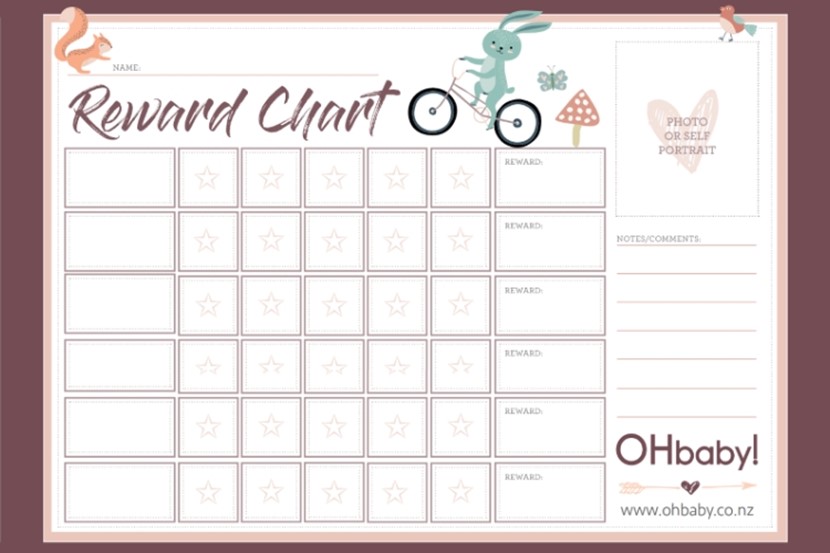
Download and print a reward chart: simply click on one of the charts below to open it as a PDF.
How to use your reward chart
Step one: What behaviour do you want to change?
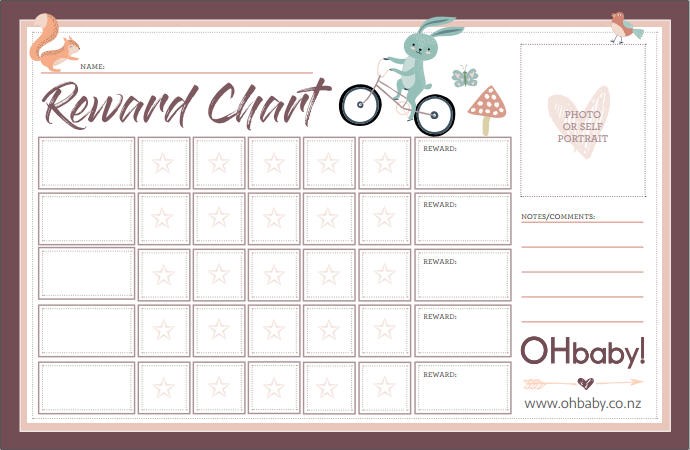
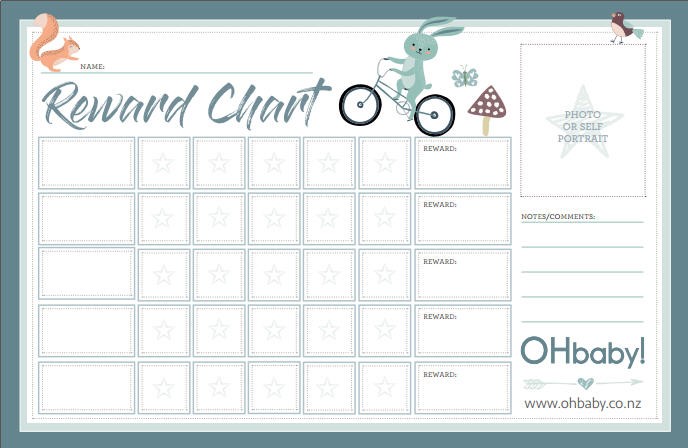
You may already have a few behaviours in mind that you want to help encourage your little one to change. A reward chart can help in achieving those goals. The basic premise of a reward chart is to reward the positive behaviours you want reinforced in your child, rather than focusing on the negative behaviours. Reward charts generally work better with children over the age of two. On the left side, write the behaviours you want to encourage, with five stars to be ticked,coloured in, or covered over with a sticker each time your child displays the behaviour you've decided upon. Once your child receives five stars, they get a reward, which you can decide on and write down on the right side of the chart.
To encourage your little one to use the chart and enjoy the process, you may like to get them to interact with you and help you to fill it out. There are stars in the "rewarding" boxes for each display of good behaviour. You may like to tick inside the star with different-coloured markers, or perhaps use small stickers or sparkly beads you could stick on with blue tack or double-sided tape. You could take your child shopping to choose what to mark each star on the chart with. Doing this also helps to explain what your purchase will be used for and how the chart will work. Sit down with your child and write his or her name on the chart together, and draw pictures on the chart, perhaps to represent the behaviours the chart will address (a plate with food on it for eating dinner; a pair of big-kid undies for using the potty).
Ages and stages behaviour tips:
• Examples of behaviours you may want to encourage could be potty/toilet training, eating their meals, playing nicely with siblings, listening, having good manners, social graces, communication, and tidying up.
• Be specific about the behaviours you would like to see. The younger your child is, the more specific the chart should be. For example, "Have good manners" needs to be broken down into "Say please when you ask for something and say thank you when you receive something", and "Listening" could be more specifically "Doing what Mummy and Daddy tell me to do straightaway."
• No double negatives when writing your reward item. Frame things positively: Instead of "Don't be rude!" it could be "Say please and thank you."
• Limit the time that each behaviour that is on the chart. When your little one is displaying these behaviours on their own without needing to be reminded, the chart will become redundant, so keep these behaviours fresh to encourage their continued use without necessarily being rewarded for them. It's okay if you need to reintroduce reminders later.
• Limit the number of behaviours by age - the younger the child, the fewer behaviours, e.g. 24 months = one behaviour at a time, 30 months plus = two to three behaviours, ages three and up = no more than five behaviours at one time.
Step two: Rewarding each good behaviour
Each time your little one has earned a tick or sticker in the reward area, the reward should be both the tick on the star and verbal praise of that behaviour. So rather than a generic "Good girl/boy!" praise, you could say, "I really like how you put your toys away" or "I am proud that you went to the potty when you needed to use it!"
• Younger children need a short time span between the behaviour and the reward. You may wish to make the rewards a bit more immediate so that your child understands the correlation between the good behaviour and the immediate positive outcome, e.g. praise and a little treat, then get them to put the star on the chart.
• Another fun way to mark your child's reward is to give him or her an option such as, "Would you like a pink sticker or a blue sticker on the reward chart?"
Step three: The big reward
Believe it or not, lollies don't have to be the main reward. The younger the child is, the more immediate food treats might be in rewarding behaviour; however, you could look at other treats, such as toys that they have asked for, a trip to their favourite playground for a picnic, a visit to the zoo, etc. In an ideal world, the reward will be related to the behaviour you are rewarding, and you can talk them through this as well so they understand it. For example, if the behaviour is being kind to a sibling, the reward could be doing something with that sibling together. If it's toilet training, the reward could be choosing their own new underwear from the shop. If it's tidying up, the reward could be earning a toy they have wanted. For listening to Mummy and Daddy, the reward could be that your child is the boss for 30 minutes. If it relates to eating, the reward could be food-related, getting $2 to spend on lollies, or dining out somewhere as a treat.