
How much can babies hear, exactly? And what should you do if you're concerned about your baby's hearing? Elizabeth Gasson talks to clinical audiologist Dr Richard Bishop about infant hearing.
How can I tell if my baby can hear?
It can be very hard to tell if your baby can hear you as their ability to communicate is so limited. Normally hearing babies will often respond to changes in sound by stilling or startling. These signs can be inconsistent, however, and often a suspicion that the baby cannot hear properly builds over time.
What are some of the common causes of hearing problems?
Hearing problems in babies are most frequently associated with middle ear problems. Usually, these problems are temporary, but sometimes developmental abnormalities of the foetus lead to structural abnormalities of the middle ear. Less frequently, sensorineural deafness develops in utero, in the neonatal period, or during the first few years of the baby's life.
How do you test for these problems?
At this age, we are most concerned about the sensitivity of the ears to sound, and generally we assume that normal sensitivity for sound means normal hearing.
A Universal Newborn Hearing Screening programme is currently being rolled out through New Zealand's public hospital system. The idea behind this is to try to screen ear sensitivity in the first few days of life before the baby leaves hospital, to try to identify those infants with congenital deafness.
There are two complementary screening systems which look at slightly different aspects of hearing function. Otoacoustic emissions, or cochlear echoes, measure the mechanical function of the cochlea, the sense organ of the hearing system.
Auditory brainstem response systems measure electrical activity evoked by sound in the auditory system. Both of these screening procedures are highly automated, non-invasive, and can be done while the infant is sleeping. With older babies, it is critical that their arousal level is at an optimal state. If the baby is too sleepy, or too agitated, it is extremely difficult to assess their responsiveness to sound. If there is sufficient concern, the baby might be admitted to hospital and the tests done under sedation.
Generally, however, obtaining behavioural responses to sound is preferred, rather than relying entirely on fancy equipment.
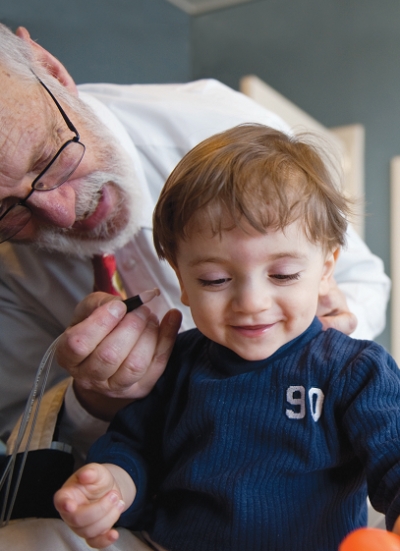
Usually, by the time that the baby is able to sit unassisted, behavioural measures of sensitivity can be obtained in what we call free field situations. In these situations, the baby plays in a controlled sound environment, various sounds are introduced, and the baby's response is evaluated. A surprising amount of information about a baby's hearing sensitivity can be obtained in this way.
At any age, more common types of infant middle ear problems can be tested for using equipment called a tympanometer. This is a painless process which measures the eardrum's response to small changes of pressure applied in the ear canal.
Do the tests hurt?
The tests don't hurt, but they can be a little uncomfortable. Usually, the degree of discomfort is not sufficient to wake a sleeping baby. Parents are often more agitated than the child during the tests!
How long will it take to get the results?
Usually results are available straightaway, although sometimes tests are inconclusive, and further appointments may be needed to explore a bit more.
What can be done if my baby has a hearing problem?
The most common type of middle ear deafness found in infants will usually respond to medical or surgical treatment. For instance, if the baby has chronic middle ear congestion, which does not respond to antibiotics, grommets will be recommended by an ear, nose and throat surgeon.
With less common structural abnormalities of the middle ear, reconstructive surgery may be used when the child's head has reached adult proportions.
With moderate to severe degrees of deafness, sensorineural or less common types of middle ear deafness, the baby will be recommended hearing aids. The goal of the universal neonatal hearing screening programme is to have babies fitted with hearing aids by the age of six months.
In cases of more severe and profound degrees of deafness, the family will be offered a choice of using hearing aids, or for the infant to have a cochlear implant. Immersion in a visual sign language environment is another option.
The sooner the hearing deficit is managed properly, the less severe the impact on the development of the child's language structure.
What can I do to protect my baby's hearing?
A baby's ears can be damaged in a number of ways. It is very important not to clean the ear canal invasively; it's true that nothing smaller than your elbow should be put into the ear canal!
Blows to the child's ears can cause serious damage to the middle ear and cochlea. These can occur accidentally in play, or they can be deliberately delivered. Serious head injuries, especially those involving concussion and skull fracture, can result in impaired hearing.
Chronic middle ear congestion can result in long-term changes of the middle ear structure and in developmental abnormalities of the auditory system. Having your baby undergo regular tympanometry at your family doctor is the best way to discover this problem.
Sometimes food intolerances such as dairy intolerance, and other allergies, can trigger middle ear problems as well.
Exposure to high levels of sound can permanently damage the sense organ of hearing in anybody, including infants. There are two types of sound to be concerned about.
Steady sound, such as from a motor, skateboard, or plastic tricycle, can cause damage if the exposure is too prolonged or frequently repeated.
Impact noise, such as from fireworks or firearms, can sometimes cause immediate damage from a single close exposure.
The best policy is to keep babies away from power tools and noisy working areas, limit their play with noisy toys, and try to avoid close exposure to impact noises.
What are the consequences for my baby's hearing if my baby has chronic middle ear problems?
Inadequately treated middle ear problems can result in permanent damage to the middle ear structure. More subtly, chronic middle ear problems can adversely affect the child's auditory system development.
The rate of a human brain development is considered to be greatest in the first three years of life. How the brain develops will be infuenced by its experiences, and this is also true for the auditory system. Fluctuating deafness, which is associated with congested middle ears, increases the risk of developmental abnormalities. These problems lead to difficulties in developing speech and language skills. Sometimes children do not learn to speak clearly; sometimes the complexity of their language use is limited.
How can I find a good audiologist who sees young children?
In New Zealand, all audiologists who are members of the New Zealand Audiological Society (MNZAS) will, in principle, be able to assess young children. However, some of them prefer not to, and some of them may not have the facilities needed. For instance, very few audiologists outside of public hospitals have access to free-field testing facilities. However, make enquiries of your local audiologists to find out who has an interest in this area and how they can help you.
Elizabeth Gasson is mum to one-year-old Johnathan. Dr Richard Bishop is a clinical audiologist with bay audiology in Thorndon, Wellington. Dr Bishop was the second graduate to be appointed as an audiologist in New Zealand.

AS FEATURED IN ISSUE 8 OF OHbaby! MAGAZINE. CHECK OUT OTHER ARTICLES IN THIS ISSUE BELOW
Cookie Policy | Terms & Conditions | Privacy policy | Copyright © 2024 www.ohbaby.co.nz. All Rights reserved.